Home Insurance in Sand Springs, Oklahoma
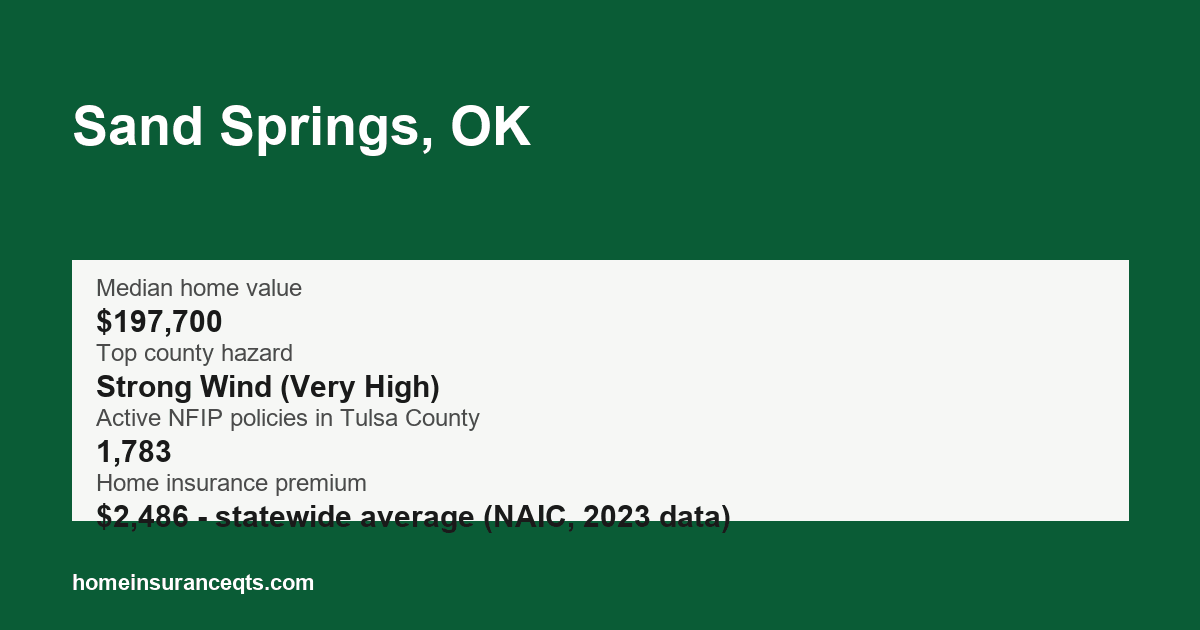
Homes in Sand Springs carry a median value of $197,700 - 14% lower than the Tulsa County median.
The typical home in Sand Springs was built around 1981. Because older housing stock often has aging wiring, roofing or plumbing, it can cost more to insure or rebuild. About 26% of homes were built before 1960, about 3 points above Tulsa County's 23%.
The housing stock in Sand Springs is 81% single-family homes, 11% apartments in buildings with 5+ units and 4% mobile or manufactured homes. Mobile and manufactured homes typically need a manufactured-home (HO-7) policy rather than a standard homeowners policy.
In Sand Springs, about 67% of owner-occupied homes have a mortgage - lenders require hazard insurance on every mortgaged home.
The vacancy rate is 6%; vacant or unoccupied homes typically need a different coverage form than an owner-occupied policy. About 71% of occupied homes in Sand Springs are owner-occupied.
In Sand Springs, 72% of homes are primarily heated with natural gas.
FEMA rates Tulsa County's overall risk as Relatively High, led by strong wind (Very High). Tulsa County had 1,783 active NFIP flood policies as of September 2026. See the full Tulsa County home insurance overview for all FEMA hazard ratings and flood coverage details.
In Oklahoma, the statewide average premium for a standard HO-3 homeowners policy is $2,486 per year (NAIC, 2023 data).
Key figures
| Median home value | $197,700 |
|---|---|
| Median year built | 1981 |
| Owner-occupied share | 71% |
| Share of owner-occupied homes with a mortgage | 67% |
| Top county hazard | Strong Wind (Very High) |
| Active NFIP policies in Tulsa County | 1,783 |
| Home insurance premium | $2,486 - statewide average (NAIC, 2023 data) |
Nearby towns
Sources
Data last updated: 2026-09-29
- U.S. Census Bureau Gazetteer Files (2024)
- U.S. Census Bureau, American Community Survey 2020-2024 5-Year Estimates (2024)
- FEMA National Risk Index (December 2025)
- FEMA OpenFEMA NFIP Redacted Policies v3 (2026)
- NAIC Dwelling Fire, Homeowners Owner-Occupied, and Homeowners Tenant and Condominium/Cooperative Unit Owners Insurance: Data for 2023 (published 2026) (2023)